
Author: Amber Gionet
The North Shore Golf Club, located in Nipigon on Golf Course Rd off highway 11/17, hosts several golf tournaments during the season. If you’re a local golfer wanting to put a team together, or a golfer from the region looking for a new course to compete on, you’ve come to the right place! For updated information and to register, be sure to contact the North Shore Golf Club, or join the North Shore Golf Club Facebook Group. While Golfing in Nipigon remember to plan your accommodations, plan to eat at the clubhouse or check out Nipigon’s many restaurants and visit the local shops!

May 30th – MUD OPEN (18 HOLES)
– 4- man/women teams.
– Dinner and prizes afterwards.
July 11th – NORTHSHORE OPEN (27 HOLES)
– Single- man stroke play (flighted, handicap required).
July 17th – CORPORATE CUP (9 HOLES)
– Local and surrounding area businesses/corporations get together for a fun
afternoon of golf.
– Social, prizes and dinner afterwards.
September 12th – NORTHSHORE 2-MAN (27 HOLES)
– 2-man “best ball” (flighted, handicap required).
– 39 Teams.
September 19th – 20th – NORTHSHORE 4-MAN (36 HOLES)
– The club’s most popular tournament.
– Field is spilt into an A-side/ B-side after day 1.
– Prize money is the same for “Top 3 teams” from each division.
– Steak dinner on Saturday evening which is included in the registration fee.
September 26th – MUD CLOSED (18 HOLES)
– 4 man/women teams.
– Dinner and prizes afterwards.
The largest brook trout in the world was caught in the Nipigon River. The date was July 21, 1915, and the angler was Dr.J.W. Cook, from Fort William Ont. (now part of Thunder Bay) The story of the world record brook trout has been told many times over the years, by a wide variety of writers, including yours truly. Like all legendary tales, there are rumours and stories about what happened that day. However, we also have some quite detailed information. The Nipigon brook trout that anglers chase today, more than 110 years on, have a direct connection to this fish. The fact that brook trout still thrive in the Nipigon fishery is no accident. Three Hydro dams, erosion, poor management and overfishing nearly wiped them out. Only a determined effort by a lot of people has allowed the brook trout fishery to sustain. More on that in a bit.

But let’s talk about the world record brook trout first. It is one of the oldest all tackle records in the IGFA book, and it has proven the most difficult to topple. If it does ever happen again, it will be on the Nipigon system.
One of the best sources of information on the world record brook trout is found in the book “Paddle, Pack and Speckled Trout,” by Edwin W. Mills. A writer and tourism promoter, Mills explored Ontario’s legendary brook trout waters – including the Nipigon – between 1930 and 1951. He also researched and compiled a vast quantity of information about the world record brook trout, including newspaper and magazine articles of the time. Here is how Mills described the day the world record happened, including several anecdotes ascribed to Dr. Cook himself. Keep in mind that in 1915, the Nipigon was a wild, untamed river. It had several falls and miles of rapids. Most angling trips took several days, and left from the bottom of Lake Nipigon, above Virgin Falls. Those fishing adventures included First Nations guides, who took “the sports” down the rapids in freighter canoes and would show them where to fish and with what.

According to the Mills recount, the anglers on July 21, 1915, composed of Dr. J, W Cook, R.J. Byrnes, H.H. Neeland and J.A. Fyfe. Andrew Lexie was the lead guide of the trip. Others in the party who witnessed the event were Lafelle Boudain. cook, and guides Jo Hardy, Sam King, Michael Bouchard, Johr Ogama, Louis Musquash, Jim Shuse and Lawrence Martin.
The group were fishing the Nipigon River, near MacDonalds Rapids, at Rabbit Rapids. The camp site here was known to be poor and the bugs bad. There was a deep pool where trout would sit, waiting for food to wash over. This deep pool is where the world record was caught. It was at 6 p.m. in the evening when Dr. Cook hooked the great fish. There has always been some difference of opinion as to what Dr. Cook used for a lure. Some accounts give it as a fly, others a cockatouche (or sculpin). The sculpin is a small, squat fish commonly found under the stones of the Nipigon River. The cockatouche have always been an eagerly sought after forage by speckled trout in the Nipigon. Forty years later, Don Gapen would tie the first muddler minnow on the Nipigon River, to mimic this minnow.

According to Mills’ book, Dr. Cook laid the question of what he caught the record fish on to rest in a CP wire story from May 12, 1949.
“The river that day was covered with brown flies,” Dr. Cook recalled. “I was fishing with a minnow. When it had settled a little below the surface, the big fish took the bite and was away.”
We don’t know much about the actual battle, but Dr Cook was using a five-weight bamboo fly rod. The author has had this rod in hand, and it had very little back bone. You can still see this legendary fly rod at the Nipigon museum.
According to the CP story, Dr. Cook played the fish and called his friends to bring the net. He played it for some time and netted it after a great struggle. Dr. Cook first thought he had landed a lake trout. But as it lay on the shore, the First Nations guides insisted he had caught an extremely large, speckled trout
Mill writes that because of “the incredulity of the general public. upon hearing of this enormous trout, Dr. Cook wisely had his mounted specimen examined by ichthyological authorities at Washington and Ottawa, as well as by scientists of the Department of Biology at the Royal Ontario Museum of Zoology, Toronto. All pronounced it as unquestionably a true speckled trout (Salvelinus Fontinalis). Its authenticity therefore is beyond question.”

The brook trout officially weighed 14 pounds, 8 ounces. The trout’s length was measured at 31 and one half inches. The depth (not girth) was 11 and one half inches. Research into the measuring techniques of the day has revealed the fish may have been even larger than recorded (see sidebar).
The brook trout’s skin was mounted on birch bark panelling, as was the First Nation custom along the Nipigon, and the names of the angler and witnesses inscribed upon the panelling. A second mount, presumably crafted at the same time, was also done. For decades these mounts toured Sportsman’s shows across North America and promoted the fishery of the Nipigon region and northwestern Ontario. Sadly, both mounts have been burned in different fires. What is left of the mount that burned in the old Nipigon museum fire, in 1990, can also be seen in the new museum.

Today, the Nipigon River is quite a bit different place than it was when Dr. Cook was around. Three dams now generate hydro electric power on the river and have flooded a lot of the once roaring rapids, including where Dr Cook caught his great fish. So how does a sustainable, trophy brook trout fishery remain here? It is a long story, but here is the short version:
In 1987, a biologist named Rob Swainson came to Nipigon to become district biologist for the Ministry of Natural Resources. He was excited to be in the community, as he was a brook trout expert and new about the world record and the river’s history. What he discovered was that Nipigon in 1987 had a badly degraded fishery, with very few brook trout, never mind large ones. Any brook trout that were caught by anglers were usually killed. On top of that, the flow regime on the river sent water levels up and down so often that erosion was a huge problem. There was also evidence of spawning shoals being exposed. What followed was several years of lobbying hydro, government and anglers to get on board and save the Nipigon brook trout. It took years, but an agreement was struck to control water levels and anglers adopted a catch and release ethic that helped turn the fishery around. To further enhance brook trout populations, a protective sport fishing regulation was applied in 2005, allowing the possession of just one brook trout greater than 56 cm (22 in) in length. This regulation allowed for a brook trout to have spawned three times before potential harvest. These changes in regulation – and angler attitude – have had a massive impact on the fishery.

I’ve been fishing the Nipigon system since 1982 and experienced it at its very worst. Back then, we would often go a full day on the river without touching a brook trout. If you did catch one, it was often not very large. Trophy sized brook trout were an extremely rare catch in the 80s and 90s. Since the regulation was change two decades ago, and thanks to catch and release, the Nipigon fishery has rebounded. Brook trout are more numerous throughout the system, and the over-all size is larger. Brook trout measuring two feet long are possible, with even larger specimens showing up. In 2025, one of my clients caught a 26-inch brook trout on the fly. That size of a brook trout is a unicorn in the fishing world.
Could a new world record be caught in the Nipigon? I believe it is possible. A client broke off a brookie last year that was as big as any, I’ve ever seen in the system. It hit not that far from where Dr Cook caught his world record 110 year earlier.
It is ok to dream big on the Nipigon River!

Sidebar: Was the World Record Brook Trout 34 inches?
The world record brook trout was caught in the Nipigon River on July 21, 1915. It weighed 14- and one-half pounds. But there has been confusion over the dimensions of the record for 100 plus years.
Both mounts display the size as 31.5 inches in length and a depth of 11.5 inches. Yet, research done by retired OMNRF biologist Rob Swainson has revealed interesting facts. He says the length of 31.5” was the distance from the nose tip to the base of the tail fin. It does not include the tail. Swainsons says this scientific measure is rarely used today and is called Standard Length. Total Length – the distance from the nose to the tip of the tail – is the modern measure. Using this measure, the world record brook trout is 34 inches in length.
The depth of the world record is recorded as 11.5 inches. This is the distance from the top of the dorsal fin to the bottom of the belly. This measure is also no longer used today. Instead, girth is the measure commonly used. This is the distance around the fish, measured just in front of the dorsal fin. For the world record brook trout, girth has been determined by adding the depth of one side, plus the depth of the other (both 9.25”) plus the distance across the belly (3”). This gives a conservative girth of 21.5″.
That makes the world record brook trout a very impressive 34 x 21.5 inches. A record brook trout that will be tough to top.

Posted by Gord Ellis
Gord Ellis is a Thunder Bay–based journalist, broadcaster, professional angler and guide, photographer, and senior editor of Ontario Out of Doors. He has published over 1,000 articles, earned more than 25 national awards, and was inducted into the Freshwater Fishing Hall of Fame in 2018.
Every year, there are votes and polls about which town or city in City in northern Ontario is the fishing capitol. While there are many communities that feature great angling, I can’t think of one other place that has such a diverse fishery as Nipigon, Ontario. Not only is there a multitude of species and opportunities here, but there’s also a real chance at the fish of a lifetime. Mix in the considerable number of places to stay, camp, gas up and eat that Nipigon provides and you have an angling destination without equal. Here are just a few of the opportunities and species available to anglers in and around Nipigon.

Brook Trout
Nipigon and brook trout fishing are synonymous. The 14 and a half pound world record brook trout was caught in the Nipigon River on July 21, 1915 by Dr. J.W. Cook. Even back then, this brook trout was so unusually large it was sent away to be verified by an expert. A replica of the great fish – and the fly rod it was caught on – are on display in the Nipigon Museum. Although Dr. Cooks brook trout is one of the longest standing records in freshwater fishing, anglers flock to the area each year to try and top it. Thankfully, strict regulation and a catch and release ethic have helped Nipigon brook trout thrive and it remains a viable fishery. Boat anglers can ply the waters of the lower Nipigon River, which can be accessed from a boat launch in the town of Nipigon or at a public launch below Alexander Dam, located 16 km. north of Nipigon off highway 585. Shore anglers have great access to the river at the Alexander Dam and on the west side of the Nipigon River Bridge, above and below Hwy 11/17. Brook trout are caught with a wide variety of techniques including casting Nipigon spoons, bucktail jig-flies and Rapala Countdowns. Fly fishing is the classic way to pursue Nipigon brookies, and flies like the Muddler Minnow, Sex Dungeon and Stimulator are popular choices. While both the Nipigon River and Lake Nipigon have brook trout, there are some anglers that prefer to chase “coaster” brook trout on Lake Superior. The coaster name is colloquial and comes from the Lake Superior brook trout’s habit of cruising the shoreline. Coasters can be caught via boat fishing or shore-casting, especially in the spring. Coasters and Nipigon strain brook trout all share the same regulation. That is a one fish brook trout limit, with none allowed under 22-inches. This conservative regulation allows a brook trout to spawn three times before it can be harvested. Thankfully, most anglers release these great and historic fish after they’ve been caught. This allows other anglers to experience the thrill of catching a trophy brook trout. For anglers who want to eat brookies, the Nipigon area has excellent stocked lakes, many of which can be accessed via a hiking trail or bush road. Stocked lakes are put and take fisheries with a five fish limit. and no size restriction. Information on stocked lakes, stocking numbers and GPS co-ordinates are available via Ontario’s Fish-Online website.

Salmon
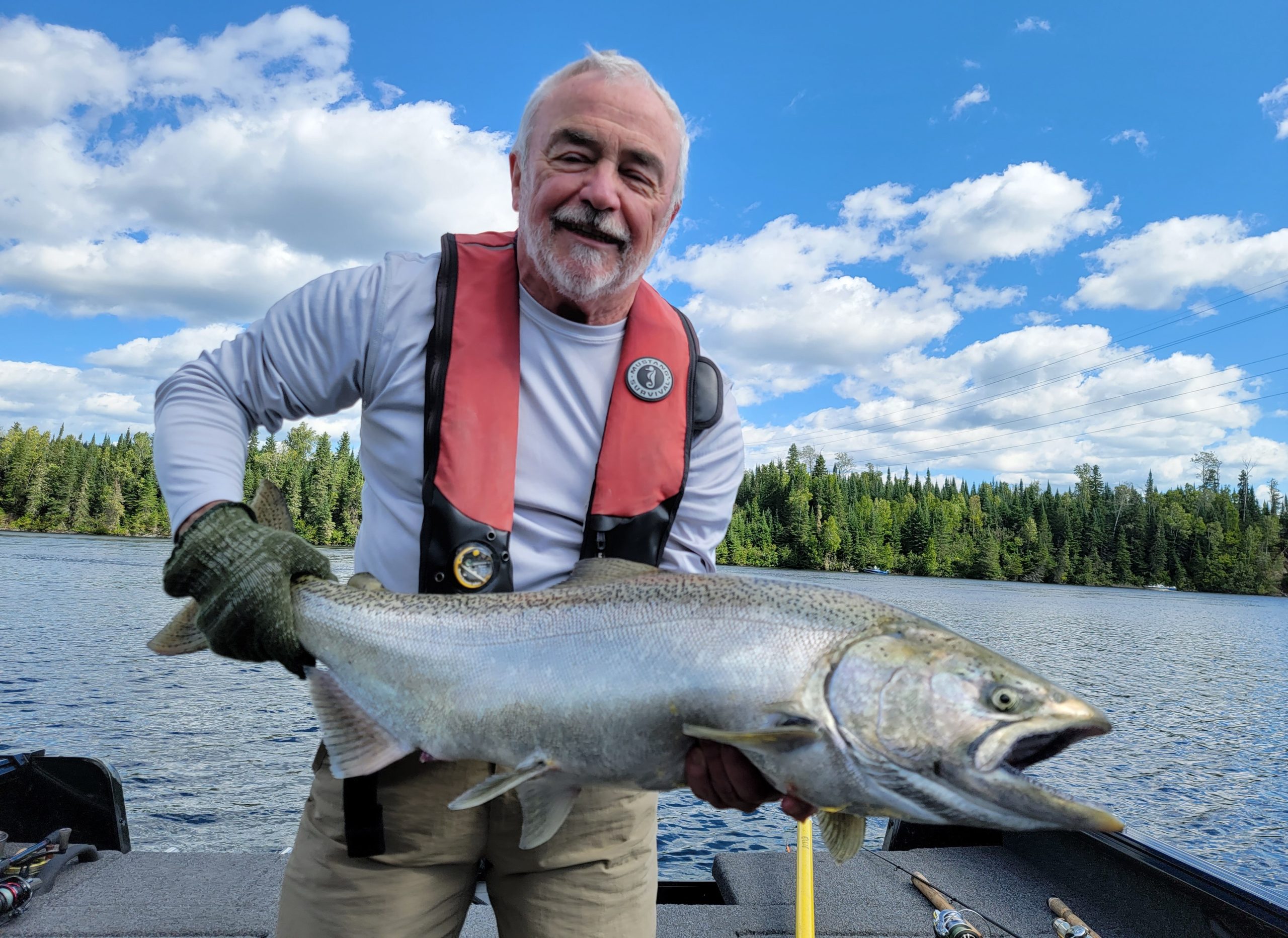
The fall run of Lake Superior chinook salmon into the lower river draws many anglers to Nipigon in August, September and early October. The annual Nipigon Fall Fishing Festival, which takes place on the labour day weekend in September, is primarily focused on the salmon fishery. Lake Superior salmon can grow large, topping 20 pounds, although an average fish is 8 to 12 pounds. When salmon are hooked in the swift current of the Nipigon River, terminal tackle and netting skills are challenged. It’s not unusual for large salmon to break line, or even rods. Most anglers troll for salmon with a jointed Rapala J-13 or similar lure and the terminal tackle needs to be on the heavier side. Strikes from salmon are savage, and you better be holding tight to the rod when it happens. Shore anglers catch salmon by casting crankbaits, spoons and large spinners or throwing a 4-inch rubber swim jigs that look like smelt. Boat anglers often troll Nipigon Bay near the mouth of the Nipigon River with spoons and downriggers to target salmon moving into the river.
Steelhead/Rainbow Trout
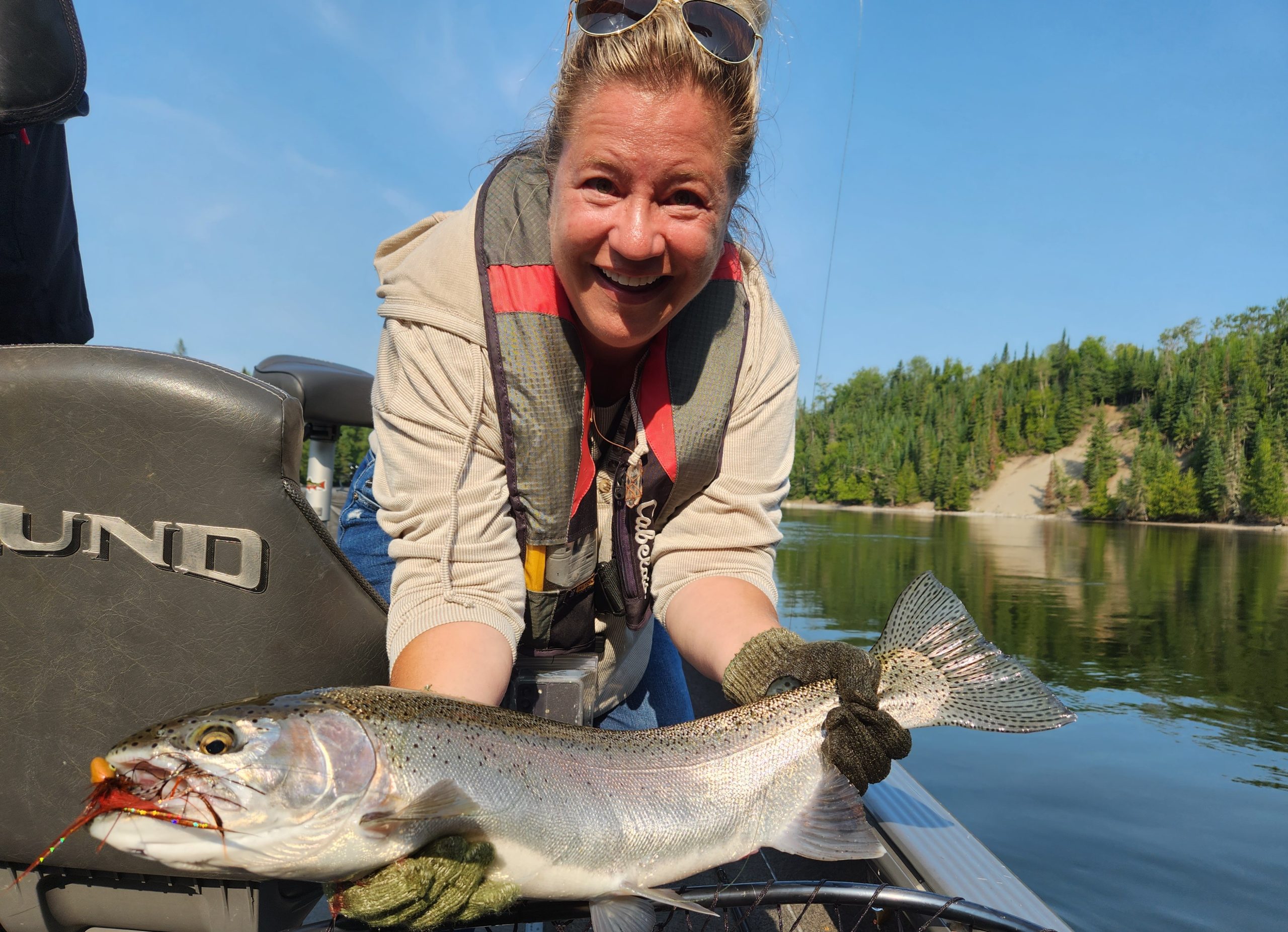
Steelhead are the name given to rainbow trout that live in Lake Superior and have naturalized in the big lake. Every spring these fish run up the Nipigon River, as well as the many tributaries that enter Lake Superior east and west of Nipigon, to spawn. The spring steelhead run is a time when anglers target these great fish. Steelhead are powerful fighters and can grow to weights approaching ten pounds. The peak of the spring run is late April to mid-May, but on the Nipigon River, it’s not uncommon to still be catching steelhead in June. Because the Nipigon River is so large and cold, I’ve caught steelhead in the river in mid-summer. There are also resident rainbow trout that never leave the Nipigon River. These fish are fatter than a typical steelhead and have a bright pink slash down the side and prominent pink on the fins. Spring steelhead anglers catch fish on brightly coloured yarn flies or roe bags bounced along the bottom or under floats. Lure fisherman can catch steelhead by casting Little Cleo spoons, Mighty Mitch and Jungle Joe Jig Flies or Mepps Aglia Spinners. Steelhead that drop back into Lake Superior will be quite aggressive near river mouths and along shoreline points well into June. This provides a wonderful opportunity for small boat/canoe and shore anglers alike. The steelhead population is also fragile, hence a conservative one fish limit. Most steelhead/rainbow anglers will release these fish as they can spawn many years in a row.
Lake Trout
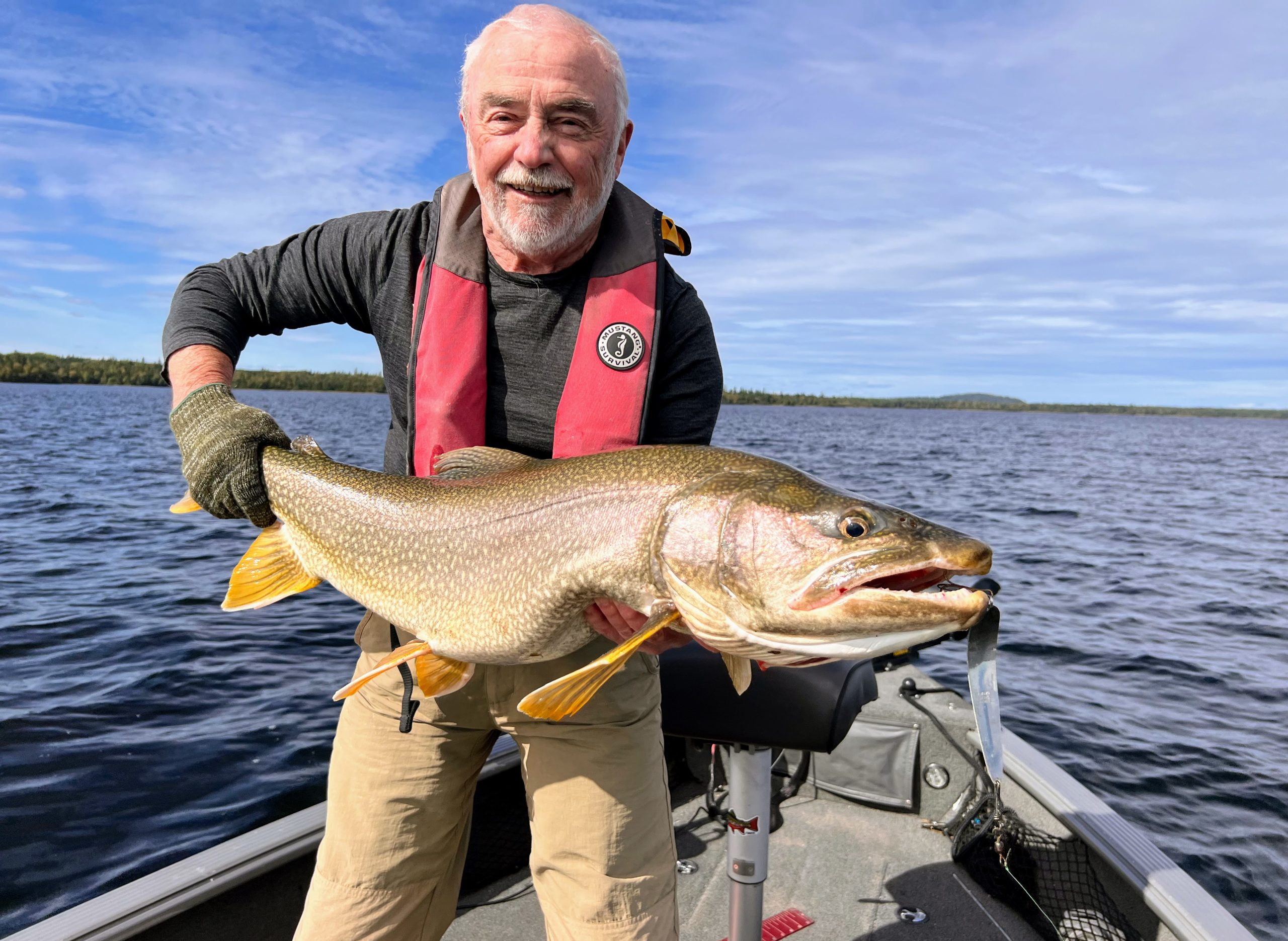
Lake Nipigon is arguably the greatest drive to lake trout fishery in North America. This huge lake is cold, deep and has not been invaded by parasitic sea lamprey. This combination allows lake trout to grow old and to a generous size. While Lake Superior (including Nipigon Bay) is home to bountiful lake trout, the average size of the fish caught is smaller than Lake Nipigon fish. Which is not to say there are not big lakers in Superior because there are. But Lake Nipigon is a place where a 20-pound lake trout is a real possibility, and catching a 30 pounder is more than just a pipe dream. Access to the south end of Lake Nipigon can be made up Hwy 585, and then via a 16 km drive down the South Bay Road. Open water fishing for lakers starts at ice out in late May and runs until the end of September, when the season closes. Anglers catch lake trout by trolling or casting in the early season when the lake trout are shallow. As the surface water warms in the summer, anglers troll with downriggers or lead core line and find the lake trout a little bit deeper. Lake trout are occasionally found in the lower Nipigon River, particularly in the spring and fall when they run in from Lake Superior. Lake trout are also landlocked in Jessie Lake, a reservoir on the Nipigon River located between the Cameron Falls and Pine Portage dams.
Pike/Walleye/Bass
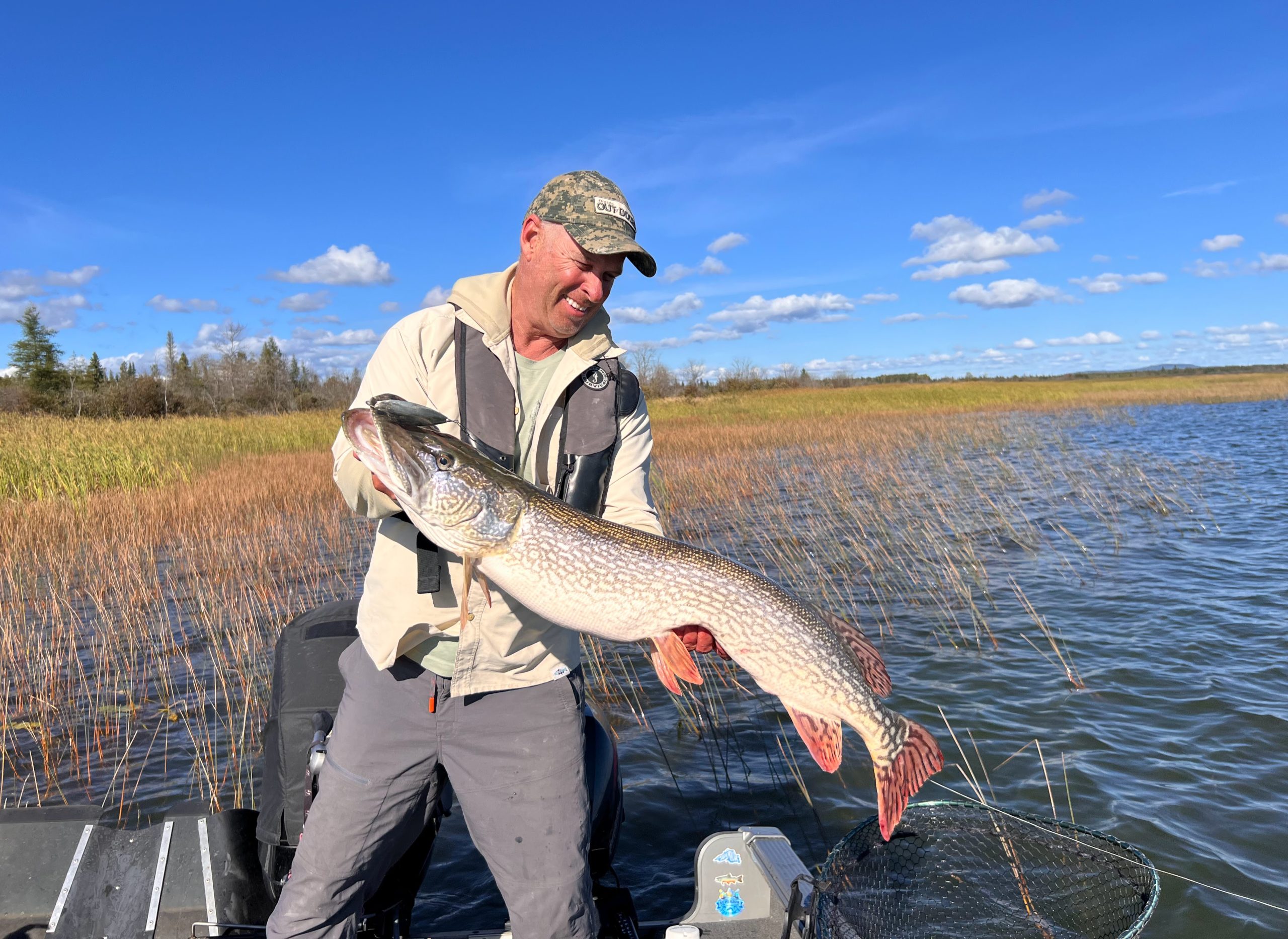
While the Nipigon region is understandably famous for its trout and salmon fishing, that’s not the only game in town. The whole Nipigon system has world class pike fishing, with some truly huge specimens found throughout the watershed. Lake Nipigon is one of the best trophy pike fisheries in North America, with both numbers and large fish. Northern Pike to 50 inches are caught every season on Lake Nipigon. Nipigon Bay, on Lake Superior, is home to giant pike, many of which run up local rivers including the Nipigon. Brook trout anglers in the river occasionally hook up on pike that measure 40 inches or more. Black Bay, located east of Nipigon Bay, also has giant pike opportunities. Walleye are protected in the lower Nipigon River and in Nipigon Bay and fishing for them is not allowed. However, nearby Black Bay, which can be accessed at Hurkett Cove, just 20 minutes west of Nipigon, has a new walleye season as of 2026 that runs from July 1-Dec. 30. An angler can keep two walleyes in Black Bay, but they must be between 40-50 cm. Trophy sized fish are a very possible catch in Black Bay, but large walleye must be released. Black Bay also has an excellent and underused population of smallmouth bass. The average smallmouth is 16-17inches but bass approaching 20-inches are not out of the question. It is very possible to catch a personal best bass, walleye and pike in three casts on this bay.
That’s a taste of what Nipigon can offer the intrepid angler. Whether you are driving through town, or staying for a week, there is an angling adventure waiting. You should come and visit Nipigon, Ontario’s fishing capitol of northern Ontario.
Posted by Gord Ellis
Gord Ellis is a Thunder Bay–based journalist, broadcaster, professional angler and guide, photographer, and senior editor of Ontario Out of Doors. He has published over 1,000 articles, earned more than 25 national awards, and was inducted into the Freshwater Fishing Hall of Fame in 2018.
Your Summer Staycation Sweet Spot
If you live in Northwestern Ontario and are craving a change of scenery without the hassle of a long drive or complicated logistics, Nipigon might just be the perfect summer staycation to consider. As you make your way along the picturesque shores of Lake Superior to the crossroads of Canada, the routine of everyday life fades into the rearview as you focus on the mountainous rock cuts, wide-open skies, and the easygoing pace of smalltown northern Ontario. Nipigon has mastered the art of simple summer fun: affordable places to stay, outdoor adventures that don’t require expert skills or expensive gear, and family-friendly attractions where kids safely play while parents take a deep breath and relax. It’s close enough to feel easy, but far enough to feel like you’ve truly gotten away from the everyday —and that’s the magic of Nipigon.

Close, Comfortable and Easy on the Budget
One of Nipigon’s main advantages for bigger city residents is how effortless the trip is. A short, scenic drive along Highway 11/17 makes it ideal for young families, multi-generational trips, or even a spontaneous weekend getaway. No need to plan months in advance or pack the entire house—just strap the bikes to the SUV, grab the swimsuits, and go.
Accommodation is another reason Nipigon shines as a staycation destination. For a small town, there’s a solid selection of motels that consistently deliver clean, comfortable rooms at reasonable prices. For families especially, this value matters. Saving on accommodations makes it easier to extend the stay, dine out together, or purchase some mementos of your trip, without feeling the pinch.
There’s also something refreshingly stress-free about staying somewhere that doesn’t feel overcrowded. Summer in Nipigon is lively but relaxed, making it easy to settle in and enjoy the town at your own pace. Most activities and attractions are walkable from downtown.

Built for Safe, Family Summer Fun
Nipigon is tailor-made for active families who want to be outdoors without committing to long, complicated excursions. The Nipigon River Recreation Trail is accessible from the Nipigon Marina. For those interested in a leisurely experience, the first 2.5 kms on the Nipigon end of the trail is flat, wide and perfect for biking and walking. If an urban walking experience is more your style, visit the Bridgeview Lookout Tower and take a walk along the paved path under and across the pedestrian walkway on the famous Nipigon River Bridge.
When the summer heat kicks in, Nipigon delivers something that’s becoming increasingly rare: great swimming options. Lofquist Lake is a favourite with locals and visitors alike, offering a refreshing place to cool off surrounded by nature. The small sandy beach area makes it easier to keep track of little ones. The laid-back, family friendly vibes make it ideal for folks looking to spend an entire afternoon lakeside. It’s spring fed, so even on the hottest days, the water is cool and refreshing. The small size of the lake and its gentle waters make it a perfect place to launch kayaks and paddle boards. Just a 10-minute drive from the highway, Lofquist Lake’s amenities include picnic tables, benches, a diving dock, ample parking and changing rooms.
The motels here don’t have pools, but no need to fret. Nipigon has an outdoor pool. With facilities like these now a rarity in Thunder Bay, enjoying the pool feels like a throwback to classic summer days. For kids, it’s pure excitement; they’ll love the diving board and slide. For parents, it’s a chance to relax poolside knowing everyone is happy. It’s the kind of simple pleasure that turns an ordinary weekend into a memorable one.

Play, Learn and Explore in the Heart of Town
Nipigon’s family-friendly appeal really comes together in its community spaces and attractions. Paddle to the Sea Park is a standout, especially for families with young children. Centrally located, the park features unique playground equipment, and a popular splash pad that becomes a hub of summer fun. It’s an easy place to spend an afternoon letting kids burn off energy while parents soak up the atmosphere.
Just steps away, the Nipigon Historical Museum offers a quieter but equally rewarding experience. Compact and engaging, the museum tells the story of the town, the river, and the people who shaped the region. It’s an excellent stop for curious kids and adults alike, adding a bit of learning and local context to your weekend without feeling heavy or overly formal.

Fishing Without the Fuss
Fishing is part of Nipigon’s identity, but you don’t need a boat, expensive gear, or expert knowledge to take part. One of the town’s most family-friendly surprises is fishing right from a dock or shore at the marina. It’s accessible, scenic, and welcoming to beginners.
What truly sets the experience apart is the local hospitality. Fishing gear is available to borrow at the marina building, thanks to friendly staff who are genuinely happy to help. For families who want to try fishing without investing in equipment—or for parents introducing kids to fishing for the first time—this removes a major barrier and turns the experience into something spontaneous and fun.
Even if no one catches “the big one,” the experience itself is memorable: standing by the water, watching the fish jump, and enjoying the calm rhythm of a cool summer evening in Nipigon.

Tee Time at the North Shore Golf Club
For visitors looking for a leisurely way to spend a morning or afternoon, the North Shore Golf Club offers a fantastic option. This charming nine-hole course is perfect for golfers of all skill levels, whether you’re a seasoned player or trying golf for the first time. Its well-maintained greens and friendly local atmosphere make it easy to enjoy a relaxing round without feeling intimidated.
The club’s location adds to its appeal. Surrounded by Northern Ontario scenery, you’ll find peaceful views of forests and rock cuts while playing. Junior players are welcome, so the whole family can even join in for a casual game, making it a shared outdoor activity that’s slower paced than hiking or biking, but just as enjoyable. After a round, the club’s patio provides a great spot to unwind with lunch and a cold drink —a refreshing way to round out a summer staycation.

Delicious, Family Friendly Dining
After a full day of fun, Nipigon’s family-friendly restaurants deliver exactly what you want: relaxed atmospheres, welcoming service, and menus that please both kids and adults. The food here feels unpretentious and comfortable, whether you’re dining in together to recap the day or grabbing a feast to go and enjoy at one of Nipigon’s many picnic spots.
You don’t need to search endlessly for a place that feels appropriate or worry about complicated dining with long waiting lists. In Nipigon, eating out is part of the fun, not a source of stress.

Short on Driving, Big on Adventures
What makes Nipigon such a strong summer staycation choice isn’t any single attraction—it’s how everything fits together. The short drive makes it doable even for a single night, while the value in accommodations makes a longer stay easy to afford. Activities are affordable, accessible, and genuinely family oriented. There’s room to be active, space to slow down, and enough variety to keep everyone engaged.
Nipigon offers a reminder that you don’t need to travel far to feel refreshed. Sometimes the best summer memories are made just down the road, in a place that welcomes you like a local and lets you enjoy the season exactly as it should be: easy, sunny, and full of small moments that add up to something special.
If you’re looking for a summer getaway that’s close, affordable, and packed with simple joys, Nipigon is ready when you are.


Posted by Suzanne Kukko
Suzanne is a Nipigon-based outdoors writer who enjoys all-season adventures. Her heart is in Northwestern Ontario, where world-class hiking, trails, and pristine wilderness call her name most weekends.